Tuesday, December 17, 2019

12/16/19 Derek Coffey PD1

Derek Coffey                                     12/16/19

Aim: How can we introduce Norse mythology by studying their philosophies? 


“All the best Northern tales are tragic, about men and women who go steadfastly forward to meet death, often deliberately choose it, even plan it long beforehand. The only light in the darkness is heroism.” 

I agree with the quote because as seen in many Norse myths a character must sacrifice themselves for the greater good. They have no issue doing so, as they believed you might as well die a hero if we all die eventually. An example of this is when Odin sacrificed himself when he hanged himself on Yggdrasil in order to gain wisdom. 

Valhalla- hall of the slain
Pair Share: 
Slay; to kill a person in a violent way
Valhalla is a place for slain heroes located in Asgard ruled by god Odin. Understanding the meaning of the word slay can help us understand those who sacrifice themselves in a fight no matter how ugly will be rewarded by being allowed access to Valhalla.

Whole Group Discussion: What's the point of creating a land of gods where defeat is sure?
“No radiancy of joy… no assurance of bliss. It is a grave and solemn place,  over which hangs the inevitable threat of doom.”

By creating a land of so called gods where they are vulnerable to many threats, these gods become more relatable to mortals. As described by Edith Hamilton Asgard is no place of guaranteed safety as the threat of doom looms constantly. Unlike Greek gods and goddesses on their mount Olypmus, the norse gods are not safe from attacks. This makes them more relatable to mortal beings.

Reflection:

I learned a lot about Norse mythology as we begin to dive into it with all its complexities. The slide I took notice about the nine worlds helped clear up a lot of my confusion. Also I gained more perspective on how they viewed mortality and sacrifice in ones life. They believed you should go out with a bang and become a hero rather than live old to be a coward. 

Monday, December 16, 2019

12/16/19 Brendan Gallo Period 8

Brendan Gallo, Period 8, Modern Mythology 2020

We started class today by reading a quote about Norse mythology: “All the best Northern tales are tragic, about men and women who go steadfastly forward to meet death, often deliberately choose it, even plan it long beforehand. The only light in the darkness is heroism.” We were then asked to give our thoughts on the quote using Padlet, which allowed everyone to see their classmates’ answers. The general consensus was that Norse mythology reflected the Norse culture and lifestyle, which revolved around invading other people. Their lives were mostly spent fighting for a cause, and because of this many of their mythological tales were stories of people fighting for a cause. 
After giving out thoughts on the quote, we did a lot of spirit reading on Norse mythology, with small discussion thrown in. In my opinion, the biggest takeaway from this reading was the lack of good vs. evil in Norse culture. Goodness wasn’t valued nearly as much as bravery and honor were. To get into Valhalla, the Norse equivalent of paradise, you needed to die violently in battle - it didn’t matter how good or evil you were as a person. Ryan brought up how in other mythologies, your fate after death is based on how you acted as a person. The idea of good vs. evil wasn’t brought to the Norse until Christianity started to spread. 
Our next major topic was how women were represented in Norse mythology and how they were treated in the culture. Unlike the Greeks, who saw women as not much more than pretty objects, the Norse valued women highly, very nearly to the same level as men. This was because the women were in charge of doing everything the men couldn’t while they were out fighting - this mainly included taking care of the children and doing housework. Women also had many rights in Norse culture - they were able to divorce their husband and volunteer to fight, things that even modern societies only recently developed. 
The final thing we discussed was whether or not we believed Signy and Brynhild entered Valhalla. After getting revenge on their husbands, they both committed suicide with the family they have killed. These acts could be considered honorable, and thus they could have entered Valhalla. Neither of the two stories clarify what happened to them after they died.

Throughout this lesson my main takeaway was how different Norse culture and mythology was to that of other regions we’ve studied so far. While both Greek and Egyptian mythology put a strong focus on good vs. evil in life, the concept didn’t really exist to the Norse. Instead of being judged on your life as a whole, you were judged on your final moments. This lesson, along with our previous project on creation stories, really helped me see how different regions of the world can have completely different mythologies and cultures. The lesson also helped me see the strong connection between mythology and society. As we’ve discussed in the past, the Greeks treated women poorly partially because of the stories that painted them in a negative light. However, Norse culture treated women as near equals to men because they were shown as nearly equal in the stories. I’m going to use my newfound knowledge to focus on the uniqueness on Norse mythology and find more connections between said mythology and society.

Friday, December 13, 2019

12/12/19 Kelly Chan PD 7 Blog #2

12/12/19 Kelly Chan PD 7
Aim: How does the story of Noah’s Ark symbolically serve humanity?
Before we discussed Noah’s Ark, we took our vocabulary quiz for unit 4.


Then we started off with this Do Now: What is the most heinous sin? What crimes are
so heinous that God would require an Earth-wide purification?


The discussion initially started off with the most basic of crimes such as stealing and
murder. But then our discussion evolved into how the most heinous sin is something
more: the choice to give into evil. Within my group, we connected back to how even
from the beginning of humanity with Adam and Eve, God gave humans choice. Although
Adam and Eve were made in God’s image and consequently perfect, He gave them the
choice to eat or not eat the forbidden fruit. Eating the forbidden fruit ultimately gave Adam
and Eve the knowledge of pain and suffering, which created the original sin. From then on,
every human had of sin, and it became a choice of whether or not to give into this sin. Many
of the people chose to give into sin and lose faith in God in the story, which is what
warranted the release of a flood. The reason Noah was chosen by God to build the ark
and to survive the flood was that although he has sin within him, Noah chose not to give
in and to continue being faithful to God. Another sin mentioned that was similar was from
Steven, who said heresy. He called this the major sin because it shows the lack of faith in
God, which would be another reason to warrant a flood. 


After establishing this, Ms.Peterson tells us to Google “ancient flood,” and Googles spits
back many sources on flood myths. She emphasizes that there are many different flood
myths across many different cultures, and connects it back to Greek mythology. Billy adds
on and talks about how Zeus unleashes a flood on the humans because they were too
brutish and violent, and how Zeus saved Deucalion and his wife, similar to how God chose
to save Noah. 


Steven then adds that the flood has both a physical and metaphorical meaning. For so
many different cultures to mention a flood suggests that the flood may have been an
actual event. Additionally, the flood represents cleansing and rebirth. I connect this back
to the discussion we had with Mr. Misciagna about the Book of Revelations, which was
the end of the beginning. In the same way, the flood was the end of a dark time, and like
in the Book of Revelations, the beginning of a new and better world. 


After we watched a video about the building of an ark replica. The news reporter in the video
asked if the replica would be used to convert others to Christianity, and the pastor replies
that that was not the main goal of the replica, but rather just to display how fantastic and
grand the ark was in the story. 

Ms. Peterson then asks the class how the video demonstrated how people viewed
the story of Noah’s Ark. The class talked about how the story is centered around the
superiority of man despite our flaws, which lead to our last question.


Is humanity doomed for failure? Why make us imperfect if we’re destined to disappoint?
The answer comes full circle to the idea of choice. Humans will always be imperfect;
mistakes are inevitable. But to choose to learn from these mistakes is what can save us
from doom or failure.

Reflection:
Before this lesson, I never really understood the real meaning of Noah’s Ark and only
knew the story on a very superficial level. From this lesson, I left with a new understanding
of the story. First, the idea of choice. It is prevalent not only in a religious or moral context
but also in normal life. It’s not necessarily the things that happen in our life that define
us, but rather how we choose to react. Rather than get swept up in our misfortunes, we
should take a step back to understand what we have done wrong, and make an effort to
prevent the same mistake from happening again. Second, patience. Noah waited 40 days
and 40 nights for the flood to end, and in return, he was rewarded with life and a better world,
devoid of the wickedness he once lived with. To have faith in God or to generally have hope
for a better future reduces suffering and gives us patience. And I think that's the perspective
we should have as we continue to live our lives.

What Should the Blog Look Like?

What should the blog look like?
One student will be responsible for writing a blog each day which includes:

  • The date
  • Your FULL NAME and class period
  • The aim
  • Notes for the day
  • MOST IMPORTANT:
  • Student reflection of the day's lesson: 
    • What did I learn?
    • Why did I learn it?
    • How will I use what I learned?
  • Student's full name and blogger number

**Students MUST LABEL their blogs using (at least) one of the appropriate labels:

  • Modern Mythology 2020
  • Sophomores 2020
  • Announcements
  1. Students are responsible for keeping track of when it is his/her time to blog.
  2. Students are to comment and respond to one another, including asking questions or asking for clarification.
  3. Blogs will be published on the world wide web, so we must practice digital citizenship and remember that our audience GLOBAL, so our tone is FORMAL.

Sample Excellent Blogs


What does your blog grade mean?

  • MASTERY (MAX): Great work, you nailed it! You covered an amazing multi-media summary of what happened in class using a clear, easy-to-read format. Most importantly, you absolutely included fantastic reflection which addresses all three main questions with depth beyond the classroom.
  • APPROACHING (APP): Your summary got the general gist of what happened in class, but could definitely use some elaboration OR your formatting is not aesthetic OR your reflection may be basic (such as just reflecting on how it can be applied in your schooling instead of the real world). 
  • DEVELOPING (DEV):  You probably didn’t include a reflective aspect at all or your summary was so minimal it was hard to have any idea what happened in class.
  • NOT YET (NY):  Incredibly basic and/or the tone was rude, offensive, or inappropriate for a school, public blog.
  • M: No blog written on your assignment day.

Can I fix my blog grade?
  • Blogs will receive a letter grade within 7 days of publication based on the rubric above.
  • Blogs may be revised, edited, and updated if the student would like an opportunity to improve his/her grade. IF the student does opt for a revision, he/she MUST EMAIL ME with a direct link to the published blog to inform and notify me to check the blog again.


12/12/19 Katrina Chung PD1


12/12/2019 Katrina Chung PD1 Blog #3

Vocabulary Quiz-Unit 4

Aim: How does the story of Noah's Ark symbolically serve humanity?
Do Now: What crimes are so heinous that God would require an Earth-wide purification?
  • For the do now, we talked about how the Earth-wide purification is based on multiple occasions and not just one thing. These combinations of sins are what causes a loss of universal morality. When everyone does not know the difference between right and wrong, that's when the crimes of humanity are brought to God's attention.
After the do now, we watched the Noah Ark's summary video. God took note of the wickedness of men, but he also saw the righteousness of Noah. God wanted to wipe out the entirety of Earth to rid it of its imperfections, men, and start anew. He declared that he would flood the earth to rid Earth of the wickedness men possess. God asked Noah to build an ark for him, his family, and a few of the animals of Earth. He then flooded the Earth for 40 days and 40 nights through non-stop raining. After the flood and the water lessened, God told Noah to leave the ark. Noah then built a shrine for the Lord and God told Noah that nothing like that would happen again; it would be a time for prosperity and happiness.  

Questions to Consider:
  1.  How would Noah be perceived today? How do you think he was perceived by others then? The story of Noah would probably be seen as a folderol if it was told today. In today's society, there is a diversity of cultures and differences in beliefs. And these beliefs are shaped by experiences and information given by others. Also, if a man came up to you on the ferry and told you it was the end of the world and to save yourself, you had to stay with him, you would probably just think "Ah, just another day in New York" or "this man is crazy". Back then, others would have thought differently. They would have believed Noah's Ark and thought that God was doing this to punish them.
  2. Considering your response to #1, what lesson are we supposed to derive from the Judeo-Christian God's influence on Noah?  Noah's Ark is a story to teach the importance of being a righteous and fair person (basically a good person). It also teaches the importance of patience for a better end.                            
  3. Think Critically: Why do people believe? People start to believe when there is a certain moment in life that strengthens their faith and motivates you to believe. Believing is fundamentally comforting. It gives you a plan and a kind of reward for those who do good things. Another reason why people believe is that religion is constantly evolving. Throughout time, it is the survival of the fittest religion. More people are introduced to people by spreading and becoming more prominent. 
  4. What/ Who benefits from this belief on the grander scale? I think that everyone benefits from the story of Noah's Ark. It teaches people to be good and avoid wickedness and be patient for the finer things in life. 
Is Humanity Doomed?
It seems as though humanity is always doing something to muddy the waters of anger our creators. Are we doomed for failure? Why make us imperfect if we're destined to disappoint?
  • One defined characteristic of humans is our imperfections. But we learn from these imperfections and do better. 
  • We, as humans, are not doomed for failure if we can learn from our mistakes and not make the same ones over and over again. If we never learn from them, we basically don't know the difference between right and wrong and that we don't know what we are doing wrong. There is no change.

Today, I learned the story of Noah's Ark and its importance. It teaches us the importance of planning ahead, patience, and being the best person we ourselves can be. It also shows us that our beliefs can change. Noah's Ark is to tell the story of God "punishing" humanity for their wickedness. But in the end, God restored life to Earth. This teaches us to be patient. Our sufferings would be over or reduced if you have faith that it will get better. Our ideas are constantly conforming to what we use the most and how we perceive them in our daily lives (God of Social Media, etc.)

Thursday, December 12, 2019

10/11/19 Daniel Choi PD1

Today in class Mr. Misciagna came in and talked about the book of Revelations in the bible.
Revelation is basically "The end as we know it."
Mr.Misciagna talked about how the world will end and life will start again just like the story of Noah's ark. 
We learned about the book of revelation and its history like John the apostle wrote the book.
Revelation 1:19 write the things which thou has seen and the things which are and the things which shall be better.
Revelations can be split into past present and future.
Past chapter 2-3
Present chapter 4-19
Future chapter 20-22
Revelations is the Great tribulation.
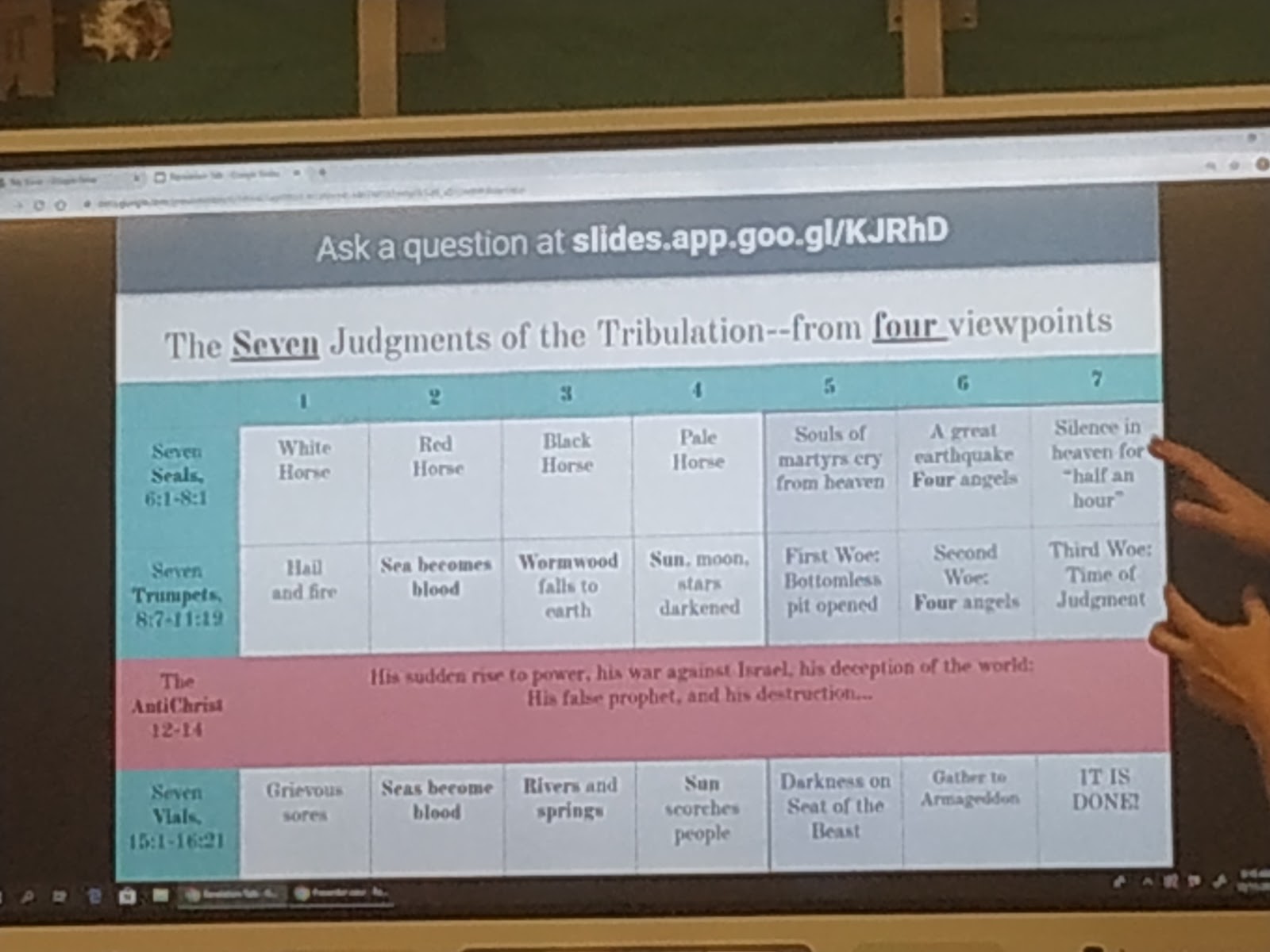
We talked about the events and elements of the tribulation. Seals were broken, 4horsemen, woman dragon, ⅓ of the earth was destroyed, scorching sun, etc
Seven judgments of the tribulation from 4 viewpoints.
The book of job is a small part of revelation.
They both suffer and in the end are redeemed.

The 4 horsemen:
White: Anti Christ
Red: War
Black: Famine
Pale: Death

The big idea of Revelations: Recompense,ruin, return, righteousness, restoration, rejoicing
There are horrific lines and beautiful lines right after.
There is a cycle of destruction and renewal in revelations.

12/12/19 Chloe Chong Period 8

Modern Mythology 2020
12/12/19 
Chloe Chong 
PD 8

Aim: How does the story of Noah’s Ark symbolically serve humanity?
D.N: What crimes are so heinous that God would require an Earth-wide purification?

(We started with a Vocab quiz- Unit 4
Ms. Fusaro was absent so Ms. Peterson subbed for her)

D.N.:
Losing the belief of God
  • As seen through the book of revelation
God says the only sin that can’t be forgiven is not believing in God at all
A bunch of things
  • Combination of 7 sins
Could also be an act of primal sins
  • Ex. Adam and Eve

Ancient Floods
  • Great flood story in almost every ancient culture
  • Ex. Norse, Chinese, etc
  • Water could be a purifying force
    • Punishment by purification 
The fact that every culture has some sort of flood myth, we can deduce that something like this actually happened
  • Epic of Gilgamesh: they also speak of a flood 

Nature Symbols
To what extent does the Judeo-Christian understanding of God controlling nature compare against the Greek mythology of mature?
  • In Christian stories, there is only one God and he wills everything. In Greek stories, many times what happens in nature is due to their moods. 
  • There is a lot more interactions between people and the Gods in Greek mythology. The God in Christianity would not interact with people as much and would only come in forms of forces such as floods. 
  • Mythology is an explanation of stuff we don’t know
  • Greek Mythology has a bunch of gods that take up smaller roles while in Judeo Christian understanding of God is an almighty figure 

The Ark
“And God said to bring two of every animal, seven pairs of clean animals, and one pairs of unclean animals”
What can be understood about the perspective of man compared to animals based on who/what was chosen to board the ark?

  • Video
  • Noah’s Ark replica 

  • Clean vs Unclean- What do they mean?
    • Clean: it is edible; Unclean: inedible (Peter)
  • God is unfair in that there is an uneven amount of clean and unclean animals but they have an equal chance on the ark
  • Balance must be maintained as there are both clean and unclean animals
  • 7 is a number of perfection*
    • Clean is Perfect but Unclean is Imperfect
    • Carrion eater is unclean because they feast on things that are not alive 
    • Antigone: Carrion birds are bird that eat dead things

Is humanity doomed?
Are we doomed for failure? Why make us imperfect if we’re destined to disappoint?


Self reflection
Today we uncovered Noah’s Ark. We started with exploring the wrongdoings of mankind and what would result in God wiping everything out with a flood. While we couldn’t pinpoint the exact for the flood, we relate back to yesterday’s lesson on the Book of Revelation and the 7 sins. We also connected Noah’s Ark to other cultures that utilized floods in their myths. I learned that the fact that every culture has a flood story must mean that a flood or something of that nature must have actually occurred. We made another connection when talking about the Judeo-Christian understanding of God versus the Greek’s understanding of Gods. I drew similarities between the nature and the Gods and related back to myths being an explanation of the things we don’t know. We then moved onto the Ark and discussed the meaning of clean and unclean. After much debate, we settled on the term unclean animals being animals that eat the dead. We also took a step back and looked at the themes of this myth. I learned that like other creation stories, balance is key. Even though the clean animals are “perfect”, there must be one unclean animal to balance it out. As mentioned by a classmate, the use of numbers plays a role in being meaningful. The number 7 is a “perfect” number as introduced in yesterday’s lesson. We ended with “is humanity doomed?” Though we didn’t have time to discuss, humanity, though flawed, is not doomed in my opinion. We have our faults but there is beauty in our flaws. We can learn from our mistakes and we have the potential to grow from them and become great. I definitely learned more about Judeo-Christianity as I’ve never really known much about it before. In the future, I will keep what I’ve learned in mind that everything happens for a reason even though it is not always fair. And a nice thing to always remember is to be a good person because whether no matter what we believe in whether it’s Heaven or Hell, the Afterlife, nothing, being a good person is the right thing to do.

Benjamin Cavallaro, Period 6, 03/25/24

  Benjamin Cavallaro, Period 6, 3/25/24 Modern Mythology 2024 Blog #3      Something that’s stuck with me since the start of the school year...