Wednesday, November 13, 2019

11/13/19 Kevin Zou Period 5


11/13/19

Kevin Zou #33

Period 5 Sophomore 2020

Aim: What are the major symbols in Macbeth and how do they create allusions and connections?
Do Now: On paper/digitally, write a note to your neighbor using only images. Trade notes to see if you can understand one another without speaking. 

  • Mark talked about drawing simple things to convey ideas. This comment implied how complex ideas are hard to express.  
  • Danielle related back to what Mark said about drawing basic images. Her partner wasn’t very good at drawing; she made an insightful comment on how the interpretation of the images depends on the person.
  • Riya talked about drawing symbols that she can associate meanings with.
  • Stephanie and Michelle C. mentioned an inside joke they can associate the symbols with. 
  • Nour, Michelle Z., and Julia all used different emojis to show ideas and emotions.
  • Meghan was trying to convey her hunger through symbols. 

Symbols:
  • represent tangible and intangible things
  • sparked the beginning of communication
  • hieroglyphics → foundation of reading and writing 

Ms. Fusaro went into how dreams are the epitome of communicating complex ideas through images. To demonstrate this concept, she asked the class to associate images with freedom. Ms. Fusaro then told us to draw an image of a tree and compare it with our groupmates. As we found, most of the trees we drew were similar. The purpose of this activity is to show how different backgrounds of people can influence their interpretations of signifiers. For example, our class mostly drew American sweetgum trees, evergreen trees, and leafless trees. This outcome could be explained by our similar experiences growing up in America. On the other hand, someone from the Carribeans will more likely draw palm trees in response to the signifier.

signifier (word) → signified (symbol) 
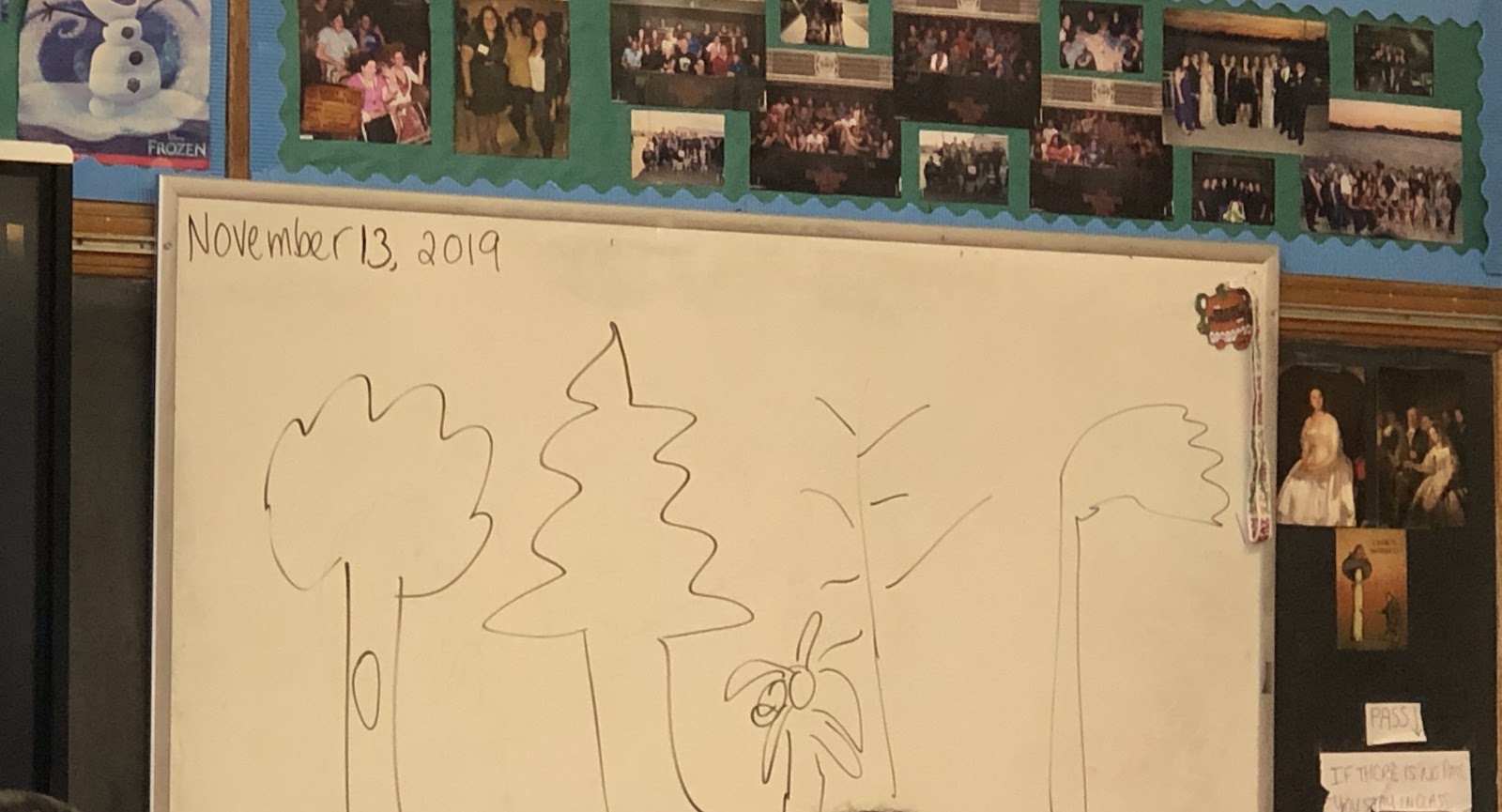

complex ideas → shaped by background/experiences → influenced signified images 
Interpretation of symbols → different ideas 

Example: freedom → eagle, the Statue of Liberty, map of the country, the American flag
  • All of the people's signified responses to the signifier word freedom were very similar as we are all American citizens. 
Pair Share 
Define “allusion” Discuss any allusion you’ve noticed in Macbeth thus far. Why are allusions significant? Why would an author choose an allusion over an explicit statement? 
  • Allusions are indirect references to something historical, literary, or political. They are significant because they can help us better understand an intricate message in literature. That being said, an author would choose an allusion over an explicit statement because an allusion is more impactful than blatantly saying a message.

A theme isn’t an allusion (universal statement) and a motif isn’t an allusion (specific to its own work). 

Shaina referenced how the conch is a motif in Lord of the Flies. She then talked about how a biblical allusion in Macbeth was Adam and Eve. Similarly, Ms. Fusaro voiced how the serpent mentioned in Macbeth symbolizes the devil. Mark inquired about if an allegory is an allusion. Ms Fusaro cleared up this question by specifying that a group of allusions is an allegory.


Macbeth Symbolism Breakdown
Devil → any temptation
Elemental symbols → create and/or destroy (too much → destruction)
Water → baptism
  • people are born with the original sin of Adam and Eve → water symbolically washes you of sins
Blood/Red → sins/passion → “crimes of passion”
White → purity/innocence
  • brides wear white (American culture focused)
Crow/raven → night and darkness (death warning) 
Milk → nurture and femininity
Serpent → biblical imagery of devil 
Light/Dark → good and evil 
Three → supernatural (Holy Trinity)
  • other examples: "body, mind spirit", triangle (strongest shape), the three Estates of France, basis of time
Day → lifespan
  • morning to childhood, afternoon to adulthood, night to elderhood)
Witches → temptation (offers information and prophecies to Macbeth) 
  • If Macbeth never knew about the prophecies, would he have done everything he did?
Sleep → “little death”
  • time cycle → life cycle (you'll never see yesterday)


Student Reflection: 
  • To summarize the main points of today’s lessons, we discussed the importance of symbolism and allusion in Macbeth and how they can help us gain a deeper meaning of the events in the play. Specifically, they can help us understand the motives behind the character’s actions and the author’s messages. All of these ideas could be hard to convey through words. Therefore, these complex ideas are often conveyed through images (symbolism and allusions) that are shaped by the author's and readers’ cultural background and experiences.

Owen Zheng Pd 5 11/12/19 Blog

Owen Zheng PD 5 11/12/19
Sophomores 2020 Blogger #32
AIM: How is imagery used to highlight the motif of promises?

Do Now:
Review Macbeth’s soliloquy, especially the conclusion
How does the imagery Macbeth illustrate his development as a character?

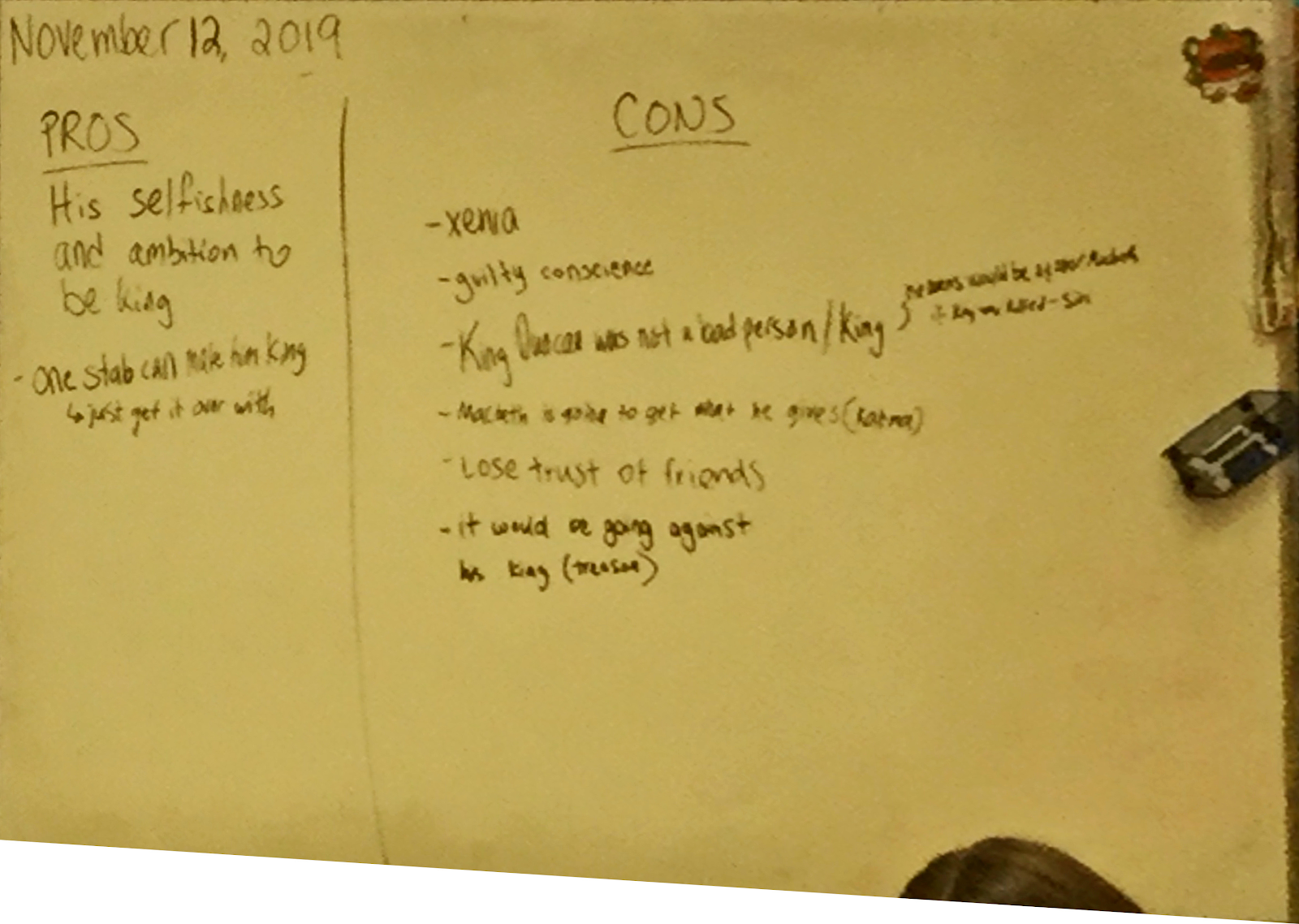
Fusaro: What are the pros and the cons of killing Duncan? 
(Today we starts discussing the ups and downs of getting rid of King Duncan. A point mentioned today is that its better to kill King Duncan now and get it over with rather than suffering trying to rid him later. A counterpoint to that is guilty conscience and xenia that it will not be easy to be king as they will try to find who kills the king and the people next in line will be paranoid. To add on, the concept of karma and divine right was introduced and the example that the universe will turn against conspirators through an example of chalices that if you poison a chalice at a dinner party, karma will make sure the chalices will swap and you may be drinking from that chalice. Divine rights means God will be mad if the king is killed. So in the end. Macbeth decides not to kill King Duncan as he can’t cover it forever and someone will find out sooner or later as too many people will be suspicious.)


Students debating the pros and cons of killing King Duncan

What could this possibly mean?
What is the meaning of this image?
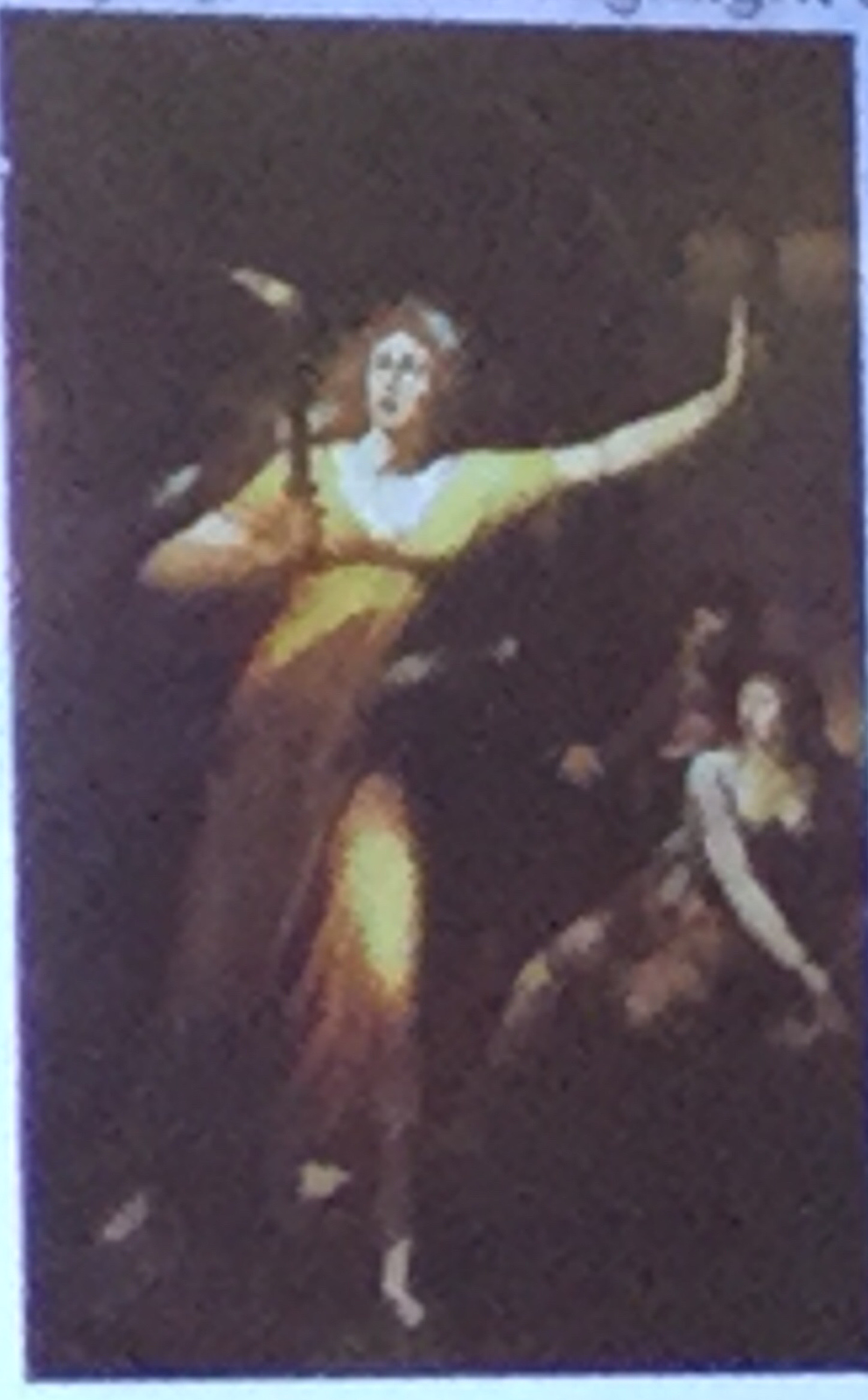
(Someone mentions that a lady is seeming bursting into a room in a nightgown, waking someone up in a hurry. She infers that it must be nighttime if the lady wearing a nightgown. Another points out her expression, describing it as it’s full of fear and she must be warning or attempting to evacuate the sleeping person. To add on, they continue to describe it as she is in a hurry, no shoes, fast slew of the flame, a candle rather than a torch. The sleeping people in the background seems confused and alarmed at what the lady is doing.)
Reading Act 1 Scene 7
(Lines 40-49 continues on as Lady Macbeth shrewdly tells Macbeth he dare not rather he would, meaning he rather not do anything at all than doing something he would regret. She compared him to a cat in the adage; Cat eating fish but would not get his feet’s wet, rather being handed fish. Macbeth argues by doing nothing is doing everything, as he already has the praise and acknowledgement of the court. She goes on threatening him to smash his child head to bits if he fails, signifying she may have lost it and to tell him to grow up or lose it all. She offers her hand in the murder by swaying the guards, offering them wine and flirting. He must up hold his end of the deal to kill Duncan or she will kill his child. This signifies the major flaw in his character is that he’s naïve, easily swayed by any suggestions of anyone else and thus easily manipulated into doing terrible things.)
Discussion 
(Lady Macbeth is obviously wrong the head and he easily sway into doing terrible things.)
 What did I learn?
I learn that Macbeth has a fatal flaw of easily persuade and being manipulated by his psychotic wife leading him to his destruction.
Why did I learn it?
I learn it to understand Macbeth grim meaning of blackmail, manipulation, and coercion, how the tragedy usually occurs due to fact the major flaw in the character like Macbeth.
How will I use what I have learned?
I will use what I have learned by connecting any motifs or connections/references to Macbeth in other works as Macbeth has a great deal of influence in today’s literature.


Sunday, November 10, 2019

Christy Ng 11/8/19 Period 2 - Blog #1

Modern Mythology 2020
11/08/2019
Christy Ng - Period 2

Today in class we worked amongst our groups to break down into detail some of the Brief Myths Arranged Alphabetically. Each group chose 2 of the individually myths from the reading to summarize and write: the plot, thematic & symbolic elements, how the myth shows similarity between the gods and humanity, and its connection to modern times. 

My group chose the two myths of Arachne and Marpessa and broke them down into this:

Arachne
Plot
A talented mortal named Arachne claims that she can weave work that is superior to that of Athena. As a result, they had a challenge to determine the better weaver. When Athena saw that Arachne’s work rivaled her own work, she was furious and hit Arachne on her head. Arachne was so humiliated that she hanged herself. Minerva felt bad for her and turned her into a spider so she could continue to weave.
Thematic and Symbolic Elements
  • Another example of the danger of claiming equality with the gods; it is dangerous to challenge the gods.
  • Athena demonstrated mercy when she turned Arachne into a spider to allow her to continue to weave.
  • Hubris is the hamartia that will eventually lead to your downfall: Arachne got too prideful of her talent and challenged Athena.
Similarity Between Gods and Humanity
  • Both humanity and gods are very prideful and capable of wrath 
  • Demonstrates an example of how even the gods are capable of mercy.
Connection to Modern Times
  • These lessons can still be applied today: we still need to respect boundaries and to stay humble of your abilities.
  • Explains the spiders ability to weave webs.


Marpessa
Plot
Marpessa gave consent to Ida, a hero, to be carried off. They were in love but Apollo also fell in love with her. Zeus allowed her to choose who she wanted to be with and she chose Ida. 
Thematic and Symbolic Elements
  • It wasn’t about which of the men was better but who she wanted to be with. 
  • It strays from the dichotomy of women that we learned yesterday where women either had to be enduring or seen as monsters. It shifts the purpose of love from child bearing and lust to a love mutual to both people. She was given the opportunity to choose her path. 
Similarity Between Gods and Humanity
  • Apollo, like many Gods, are unfaithful most of the time to their lovers. Great example: Zeus. However, most of the time they still take advantage of the woman and the woman usually don't have a choice to pick who they want. 
Connection to modern times
  • Ida was given a choice of who she wanted to be with rather than being taken by force or having to endure. It is also one of the few times that we have seen consent taking place in Greek mythology.
  • Marpessa chose a mortal instead of a God which reminded us of modern times where many choose true love instead of a higher status.


Reflection:
I believe this activity was a good way to be able to understand some of the individual myths of the reading Brief Myths Arranged Alphabetically. Since there were so many myths in the reading, it would have been hard to go over them all as a class. It is a good opportunity for group work and to break down the myths individually and then share with the class what we learned. Since each group covered two of the myths, we would be able to understand in further detail the plot, thematic & symbolic elements, and connection to modern times of 12 total myths. 
Overall, the activity was an excellent way for students to do more research into their myths and then share their findings to the class to help them further understand the myths as well. For example, one group shared about the myth of the Amazons. I thought it was interesting how they shared how the myth was connected to modern times because of the theme of women and empowering women. It also sparked an interesting conversation about whether or not they ever existed. 

I believe that what I learned from this activity will be relevant, as many of the lessons taught in these brief myths are still relevant today. Even though these myths are short and we haven’t gone into great detail with them, they are still important and relevant because of the little lessons that they teach us. For example, the story of Arachne teaches us to not overstep our boundaries and to stay humble. This, of course, is a very important lesson that we still keep in mind today. Overall, I can understand how these short myths were still important to Greek society because although they are brief, they do teach lessons and have themes within them and are good cautionary tales to tell. 

Friday, November 8, 2019

10/8/19 Michelle Zhang Period 6

NOVEMBER 8, 2019
MICHELLE ZHANG
PERIOD 6 
SOPHOMORES 2020

AIM:
How does an analysis of Macbeth’s soliloquy demonstrate that he is a round and dynamic character with many layers?

DO NOW:
1. Lady Macbeth’s soliloquy check in

2. Read the remainder of Act I, Scene V (after Macbeth walks in) and Scene VI, to be completed after reading Lady Macbeth’s “Come You Spirits” soliloquy

I.V
1. When does King Duncan plan on visiting and departing Inverness (Macbeth’s estate)?
King Duncan plans on visiting and departing Inverness for only one night.

2. Explain Lady Macbeth’s intentions and plan when she states about King Duncan: “O, never / Shall sun that morrow see!”
Lady Macbeth’s intentions are evil. She wants her husband to become king and she will even kill King Duncan to make it happen. 

3. Explain Lady Macbeth’s figurative language when she explains: “Look like th’innocent flower, / But be the serpent under’t.”  What is the meaning? What is the biblical allusion?  
Lady Macbeth’s figurative language is referring to the biblical allusion to the snake (the Devil). She wants her husband to act innocent and doesn’t know what they are planning on the outside and hide his emotions. This is related to Satan because when he was trying to deceive Adam and Eve, he acted all nice on the outside, while his intentions were evil on the inside.

4. How does Lady Macbeth’s statement compare with King Duncan’s from scene IV: “There’s no art / To find the mind’s construction in the face”?
Lady Macbeth is telling Macbeth to hide his emotions and to not show them through his face. She doesn’t want him to expose himself by putting his thoughts through his facial expressions. 

I.VI
5. What commentary are Banquo and King Duncan making about the atmosphere of the castle?  What mood does this create?   How does it compare and/or contrast to the knowledge of the audience?
The atmosphere is nice because the scene states that there is a nice smell and good air. So Banquo and King Duncan feel welcomed in the castle. This creates a calm mood for the audience and also one of suspense. That is because even though everything looks pretty on the outside, we know that King Duncan is actually walking to his death because of Lady Macbeth’s plan to kill him.

6. Explain the culture of xenia as demonstrated between Lady Macbeth and King Duncan? 
 Xenia is hospitality and welcoming those inside your house. Lady Macbeth is shown as a nice person on the outside because she’s showing a warm welcoming to the castle. However, on the inside, she’s planning to kill Duncan.

CHARACTER TYPES:
Round characters: characters who are multi-dimensional and are usually the protagonist. They tend to be more developed physically, mentally, and emotionally and are detailed enough to seem real.

Flat characters: characters who are one sided and less developed. They tend to be minor characters who are stock characters, such as the stereotypical air head, tough guy, class clown, etc.

Dynamic characters: characters who go through a significant change during the course of the story. Changes include ones of insight, understanding, commitment or in values. The protagonist is usually a dynamic character.

Static Characters: characters who do not change in the story. They remain stable through the course of the story 

ROUND CHARACTERS ARE LIKE ONIONS, THEY HAVE MANY LAYERS

Read Watch Listen: Act I, Scene VII “If It Were Done”

GROUP WORK:
1. What is being revealed in each divided section of the soliloquy?
The divided sections of the soliloquy reveal the personalities of the different characters and what kind of character type they are.

2. What character type(s) does Macbeth fit?
Macbeth is a flat character because he is not very devolved. We do not fully understand what his point of view is or what his thoughts and intentions actually are. Also we do not know whether or not he is a dynamic or static character yet, we will find out as we continue to read.

3. Who depicts more umbrage, Macbeth or Lady Macbeth? Justify.
Lady Macbeth definitely depicts more umbrage compared to Macbeth. Once she finds out from her husband that he is going to be king, she immediately decides that she will do anything to make sure he gets that position. She begins to plot King Duncan’s death. From that we can tell that she shows more madness and fury.

REFLECTION:
Today I learned the different character types and how it can be shown and developed throughout the text. Round characters are ones that are detailed and show who they really are. On the other hand, flat characters are less developed and we can’t say much about. Characters can also be dynamic which means that they develop and change over the course of the text. There are also static characters which means that they remain the same throughout the text. We learned this because we analyzed Lady Macbeth’s soliloquy and had more understanding about her character and personality. This is important because we will understand her role in the text and those of other characters as well. Understanding different character types is important because it gives us insight on the text itself. Also it helps us to focus on the basic features of a text, the characters. I will continue to use what I have learned to analyze the characters throughout the text and understand them more. 

Blogger 31


11/8/19 Steven Shi Period 7

11/8/19
Steven Shi Period 7
Aim: How self conscious are literary artists in the use or incorporation of myths?
In class, students took various Greek myths and analyzed them. Students were expected
to identify various themes and symbols, explain Gods were similar (physically, morally,
emotionally, etc.) to mortals, and connect these myths with our modern world.
Notes 
My Group’s Work:
Myth 1: Marsyas
Plot: Athena invented the flute, but threw it away because she had to disfigure her face in
order to play it. Later, a satyr named Marsyas finds it and plays it. Eventually, he overestimates
his ability, and challenges Apollo to a flute-playing contest. However, he loses, and gets flayed
by Apollo.
Themes and Symbols: The most important symbol is the flute, which represents hubris on
every level. Athena’s refusal to play the flute after she invents it is attributed to her belief that
she is better than the instrument; she deems it unworthy because it undermines her godly
stature. Marsyas’ arrogance as a result of playing the flute well leads to him challenging a
god, who ultimately punishes him for his insolence.
How it demonstrates similarity between Gods and humanity: This story reflects 2
common traits  that plague mankind: hubris and insecurity. Hubris affects all characters,
from Athena’s excessive sense of self-importance and self-love, to Marsyas’ overestimation
of his own abilities, to Apollo being blinded by his own sense of self-importance.
Furthermore, Athena’s refusal to play the flute reflects humans’ own sense of insecurity;
we as humans so are obsessed with our appearance, and the perception of others, to the
point where we are willing to sacrifice what could be interpreted as happiness.
How it connects to modern times:
From our everyday attempts to live up to expectations of beauty and success, to our
tendency to show of, the dual qualities of hubris and insecurity still prove injurious to humans
today.

Myth 2: The Hyades
Plot : The daughters of Atlas, the Hyades, nursed the god of wine, Dionysus. Beyond this
point, however, there are many versions of the story. The one discussed in the book states
that Zeus rewarded their nursing of Dionysus by turning them into stars that are part of the constellation
Taurus. Alternate stories state that after the Hyades deeply mourned for the death
of their brother, Hyas, Zeus turned them into stars. They are often referred to as the Rainers, as
they brought rain from May to November.
Themes and Symbolism:  There are themes that are reflected such as importance of
compassion and selflessness. However, the main theme is not necessarily the story itself,
but rather the role that stories like these played in Greek culture. A common theme of
Greek mythology is using stories to make sense of natural phenomena that they
didn’t entirely understand, and this is a perfect example of just that.
Similarities Between Humanity and Gods: Qualities such as compassion, sorrow, and gratefulness are seen among both mortals and gods.
Modern Context  Because we can’t possibly know everything there is to know, we often
come up with stories to at least help us explain what we think causes the unknown. The use
of the Scientific Method is a polished form of “making up stories to explain something,” but it
is significantly improved because of the ability to prove or disprove the created story and
figure out what actually happened.

Notes from class discussion
-Using the story of Arachne, Kelly explains how hubris leads to distraction, but also
explains that despite this sense of arrogance, we as humans can and should learn to forgive
and forget.

-Cornelia used the story of Leto to establish how modesty is honored more than hubris,
as well as discuss how it reinforces the common belief that we must endure.

Reflection:

Today, I was able to understand how the creators of Greek mythology connected
the Gods with mortals, be it moral, physical, or emotional. For example, stories
such as that of Leto and Marsya reinforce the theme that hubris is a detrimental
quality, and that modesty and humility are virtuous ones, while stories such as that
of Arachne reflect the importance of mercy and compassion in the face of adversity
and vengeance. These qualities ultimately bring “humanity” to the Gods, which not only
allow us to relate to them, but also use them as a means to critically analyze our own
faults. Furthermore, while working with my group members, I also was able to more
clearly understand how the themes that were prevalent in these seemingly “ancient”
stories still connect with our world today. In retrospect, just as how the Greeks’ moral
and social code were solidified in their myths, we can reflect on these same myths, and
apply many of these universal themes to our everyday lives in an effort to improve
ourselves and the world around us.

Benjamin Cavallaro, Period 6, 03/25/24

  Benjamin Cavallaro, Period 6, 3/25/24 Modern Mythology 2024 Blog #3      Something that’s stuck with me since the start of the school year...