Wednesday, November 6, 2019

11/6/19 Daniela Yevdaev PD 5


Aim: How can we assess Shakespeare’s perspective of Medieval and Elizabethan gender roles through an analysis of Lady Macbeth?

Do Now:

Image result for stars hide your fires"What does this quote highlight about Macbeth's characterization? How is he in comparison to Banquo?
- shows that Macbeth doesn't want anybody to know exactly what he is planning
- Banquo is more humbled while Macbeth is easily duped and manipulated by flattery
- Banquo isn't as strong or powerful but he is a better person in general since he doesn't keep secrets
- Macbeth just asked Banquo to be honest with him but here he is keeping a major secret to himself


How can we summarize what we perceive the roles of women were during the Elizabethan era? In medieval times?
- stayed in the household
- weren't equal to men
- had to obey the men in their lives (father, husband)
- had their own opinions on matters but weren't given the rights to share their ideas like men were
- chose to voice their thoughts by (a) manipulating their husbands, (b) favors, (c) using their influence inside the household to their advantage since they were the ONLY influence in the household
Note: The audience that is watching the play are a part of the Elizabethan era (which was the era of Shakespeare) while the roles in the play are a part of the medieval times (11th century Scotland).

Turn and Talk:
With respect to women what does “milk” symbolize? When defining milk, consider the image of a mother feeding her child what does that imagery evoke?
- symbolizes a connection made between mother and child that can't be made by anyone else
- the child's whole existence relies on the mother
- definition of a woman: kind, loving, and nurturing

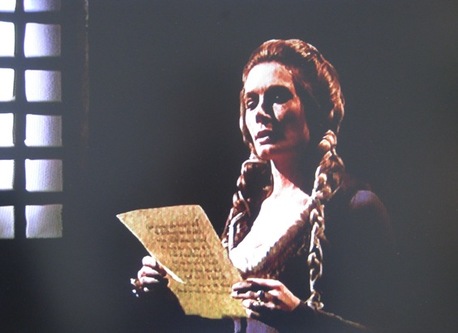
Image result for macbeth act 1 scene 5"Interpreting Act 1 Scene 5:
How does Lady Macbeth view her husband? In her opinion, what qualities does he possess, what qualities does he need to obtain? How will she aid him in obtaining those attributes?
- Macbeth trusts and respects her so greatly that he tells her information that he doesn’t tell anyone else
- "I fear thy nature", "Too full o' th' milk" → She worries that he is being too weak and too feminine
- She will whisper her own ideas into his ear as a way to influence his judgement (she practically compares her words to poison)

Student Reflection:
What did I learn?
- During this lesson, I learned about women's roles in Elizabethan and Medieval times. The main idea that we learned was that although they weren't actually given a voice in the society, they found ways to express their thoughts in creative ways. While men were off voting and participating in political events, women were at home able to use their influence to make sure that their own ideas were being put into effect as well.
Why did I learn it?
- Reading act 1 scene 5, we needed to know about women's roles during these eras as a way to fully understand Lady Macbeth and her actions during her soliloquy. She mentioned how once Macbeth came home, she would whisper her ideas into his ear as a way to make sure that they get carried out the way she wants them to. Since she doesn't fully trust his judgement she will practically "poison" his thoughts and replace them with those that she agrees with. This was one of the ways that women were able to use their limited influence in this era.
How will I use what I learned?
- Since this era was known for the gender division between men and women, the information that we found out today about women's roles in the Elizabethan era would be very helpful if this time period was ever brought up again. It would help us understand why women did what they did and how they played a role in the society.

11/4/19 - 11/6/19 Matthew Keeler PD1

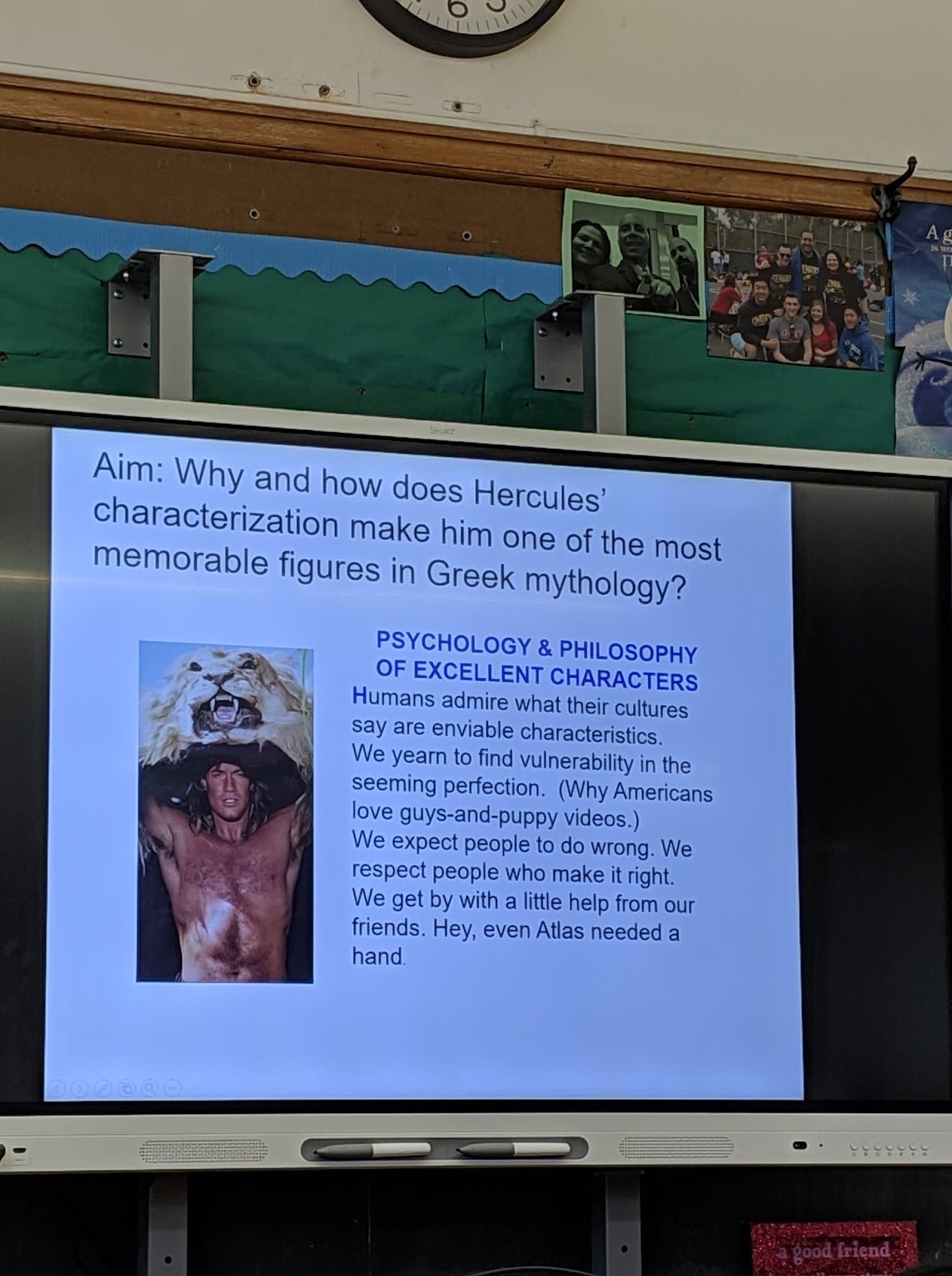
Aim: Why and how does Hercules’ characterization make him one of the most memorable figures in Greek Mythology? 

We started out the class discussing the definitions of the words “daimonic” and “anagnorisis”. Daimonic as an adjective means being motivated by a spiritual force. As a noun it is an unknown place that leads to self-destruction or self-discovery. This will lead us to either find destructiveness or creativeness and could go either way. This can lead to anagnorisis in which we come to the realization of what we do. The character makes a critical discovery and it can be the hero’s sudden awareness of the situation. 

After this discussion we watched a film adaptation of Hercules. It starts out with a fight scene in which Hercules shows of his heroism and is able to save a life and use his creativity for good. In this adaptation Hera is the one who kills Hercules’ family instead of Hercules carrying the guilt after being possessed to murder his own family. This show has more of a portrayal of Hercules as a hero. 

Aim: How are death and mortality approached in the Oedipus Trilogy?

Do Now: Think about how suicide is used in Antigone and compare it across time periods and cultures. What kind of clout does suicide have? Why does/doesn’t it bear the same weight now and today?

In Japanese culture, it was seen as a noble way to die after a war defeat. They believed that this was an honorable way to go out compared to nowadays which has a very negative connotation to it. Today theres more of a psychological impact on suicide now compared to back then when it was more of a wartime death. Additionally, in the Christian aspect of life suicide is viewed as one of the greatest sins next to murder because you are taking away one of God’s gifts which give suicide a negative connotation.

Fate Versus Free-Will
From the Greeks as learned that the more we try to avoid fate the more we play into it. Nobody (No titan or God) could change fate. 

Antigone-The First Rebel Feminist


They believed back then that killing “bad people” was justified and that justice was being served. Antigone goes against the law because she believed that it was wrong and shouldn’t be the one to say where she can and cannot bury her brother. Laws of Creon are the laws of the land and she believes that she has burial rights for her own brother. The formula for justice is really embodied with the fact that the punishment of the crime equals the magnitude of the crime that was committed. 
Universal Law must pass a cultural/philosophical litmus test. Cross cultures it is not right to commit those crimes. 
Antigone believed that the Laws of Creon do not have the power over the divine law of Greek burial. She has the power of the Gods on her side as the laws of the Gods are much stronger than anything Creon may develop. 

Today we learned about suicide and how it was viewed throughout different cultures. Our discussion continued by learning about crime and the meaning of universal law. In this we learned that according to the Greeks the law of the divine is greater than the law of the land. 

We learned this because it is important to understand why Antigone believed she was right in burying her brother. She felt that there was no law of the divine denying her burial rights, thus her crime was justified. 

We can use what we learned in future stories because now we have to take all laws that come into play and keep the idea that law of Gods outweighs law of the land.

Monday, November 4, 2019

11/4/19 Erika Yanyim PD 5


• Sophomore 2020 

• Erika Yanyim PD 5 

   Aim: How does Macbeth’s multiple or conflicting motivations    compare with his interaction with other characters advance the plot of develop the theme ?


       After watching a brief video of the movie on what we read on Friday, we were giving some short questions to do, and short discussion with the class, discussing the answers to these questions, some questions we were unfortunately not able to get to. 

1. What does the figurative language used by banquo in the “instruments of darkness” imply?
Imply that’s the witches are using their prophecies to manipulate Macbeth’s trust in them, implying the witches are not trustworthy and are inflicting Macbeth in a bad way.

2. What is Banquos warning to Macbeth?
Banquo is warning Macbeth that the witches may not be trying to take advantage of him and that he should not be so gullible when believing the prophecies. 

3. What is the promise between Macbeth and Banquo and how is it significant 
They promised each other that they will tell each other everything and not hide anything from each other. It is significant since it establishes a strong relationship between the two characters possibly developing or leading to moral conflicts further into the play.

4.  What is the foreshadowing in lines “ There’s no art/ To find the minds construction in the face./ He was a gentleman on whom I built” by King Duncan
It shows that Duncan is extremely trusting to the point where he is rather foolish. It foreshadows that Macbeth might be able to take advantage of Duncan’s trust and end up betraying him. 

5.  With the lines” Stars, hide your fires/ Let not light see my black and deep desires” What do we know about how Macbeth really feels?
Shows that Macbeth is really trying to hide the fact that he’s really being influenced by the witches prophecies from the public.  

8. With the line. “Stars, hide your fires; / Let not light see my black and deep desires.” - What do we know about how Macbeth really feels? 
This quote shows how Macbeth was hoping won’t see his real internal fear, having it be covered by his greatness and m his achievements as a soldier, he is having mixed feelings. In the quote it can be determined that he wanted to be concealed by his greatness, “...sealed by the stars...” which can be referred to as being sealed by god, the stars. 


Saturday, November 2, 2019

Tracy Liang 11/1/19 Period 2 - Blog #1

  • Modern Mythology 2020
  • 11/1/19 
  • Tracy Liang PD 2
  • Aim: Why and how does Hercules’ characterization make him one of the most memorable figures in Greek mythology?
  • Notes for the day
    • Write Now: Write about a time when you did something wrong, whether purposely or inadvertently, but for which you were extremely sorry.
      • Alexis was allowed to go to a last-minute concert even though it was a school day and was expected to come home by 12AM. However, her phone died and she ended up coming home at 1/2AM. She felt guilty for making parents feel worried and angry for not being able to reach her. 
      • Justin went on a vacation and had to leave turtle at home with no one to feed it for 3 days. 
      • Emma was supposed to take care of her turtle during the winter. She left turtle outside to run an errand. When she came back, it was dead.
      • Bobby went to the beach and brought back hermit crabs. He left them in an overheated car by accident.
      • Brian stole a book.
      • Sarina was 9 years old when she fought with her 6 year old brother and pushed him into the stairs. Her brother had bruises and blood all over and cried. She felt bad about the incident because it was her duty to protect him. 
    • Write Now: Watch the video I’m about to show you. Write down your honest, raw emotions for both the dog and the guy. Use brief words/phrases, in chronology of what you’re seeing. The more, the better. You can be honest. If you’ve seen this before, act as though you haven’t when writing emotions. 
  • Summary of Video: The short video included a dog and its owner. The dog is seen spending time with its owner. The owner tells his dog that he will be going out for a while and promises to return. The dog is shown waiting for its owner to come home. After a while, the owner finally returns home and apologizes for taking longer. The words at the end of the video say, “Make plans to come home.” It was a Budweiser commercial. 
    • Rob thought the dog was cute, questioned why the owner left the dog, “what the heck,” almost cried, and glad the owner came back.
    • Ben said that he thought the dog was going to die from starvation.
    • Another person thought it was a drink and drive video. 
    • Justin related the video back to his turtle story where he left his turtle like the owner left his dog. 
    • Mrs. Fusaro tells the class that everyone has similar emotions. The video was only one minute but brought us to so many different places. We felt mad at the owner for not coming home but he redeems himself and we forgive him when he comes home. This is related to Hercules in the sense that he also does terrible things but he feels guilty and tries to redeem himself so we end up forgiving him. Hercules’ stories are always told again and again because we find it endearing how he keeps trying to make up for his mistakes.
    • Pair-Share: 
      • 1. Read and annotate the article by Stephen A. Diamond, PhD, “Why Myths Still Matter: Hercules and His Twelve Healing Labors.” 
        • Is Hercules responsible for killing his family or should we blame it on supernatural forces? This question is related to now such as in court cases where a person may be guilty of violence caused by outside forces: defective genes, childhood trauma, faulty neurology, etc. Should they be held in the wrong for their evil deeds or should we consider those outside forces? For ancient Greeks, the answer was both. For instance, Hercules was punished by the Gods for his crimes and had to complete 12 extremely difficult tasks. He redirected his anger towards eradicating evil and could only redeem himself by doing good deeds. 
        • The daimonic: a Greek concept, anger that possesses a person to do evil. However, this anger may be redirected to positive/creative energy which could be for constructive pursuits. 
      • 2. What is your opinion on the psychology of evil? Is it ever vanquished? Are we truly our own worst enemies?
        • Evil cannot be destroyed. Hercules used his anger to help him. We shouldn’t banish evil and it will always be there. Instead, we should learn how to control it and like how Hercules redirected it to further himself beneficially. We aren’t sure if Hercules or the deities are responsible for the evil deeds done but evil can’t be banished. Moreover, everyone’s perspective of evil is different. Hercules may be a victim of circumstance. For example, people in ghettos are more likely to be criminals so should we blame society or them. In most situations, throwing anyone in a certain environment will cause them to be a certain way and we must have sympathy. Anyone may be redeemed. Hercules is still idolized after killing his family. It is a sign of strength if you can fight your own demons. Hydra is a good example of symbolism in the story of Hercules. The Hydra can replicate its heads which may be compared to evil such that evil will always exist, even when Hercules hid its head under the ground to prevent it from replicating. This shows that evil will always exist no matter what. 
      • Mrs. Fusaro asks the class how we harness/control our anger when needed. 
    • Whole Group Discussion: Does Hercules’ sensitive soul trump his ignorance and arrogance?
      • Ben says that we can’t put one above the other. One didn’t control the other: Hercules is still ignorant even with all the good deeds he’s done. 
      • Gautaman disagrees with Ben and says that arrogance and ignorance are still dominant. Hercules’ sensitive side is trumped by his arrogant and ignorant side. However, he is a better person after he went through many tests. 
  • Student reflection of the day's lesson: 
    • Today we learned how Hercules’ characterization made him one of the most memorable figures in Greek mythology. The whole concept of finding imperfection in seemingly perfection is evident in Hercules’ stories. Hercules was born as a half-God and one of the strongest/most powerful beings on Earth. However, he lacked intelligence which was one of his imperfections. Even with all this strength came weakness such as how he was vulnerable to Hera when she made him go crazy and therefore caused him to kill his whole family. All his stories show how he tries to redeem himself by doing nearly impossible tasks. He tried to right his wrongs which is something we and also the Greeks found endearing and admirable. Humans naturally admire beings that have flaws when they seem to be perfect on the outside. We respect people who try to make things right when they do wrong. Hercules redirected his immense anger and strength towards good deeds which shows how many of us today should also do that. We have the power to redirect our anger towards positive ideas/actions. Of course, anger may be used for the wrong but in many cases, it can be used for constructive purposes. I will use what I learned in real-life situations such as being more productive when I may be in a bad mood instead of sulking and doing nothing. I will also control my anger when dealing with real-life situations because I might end up regretting my actions afterward. 

11/1/19 Iandra Ramos PD 7

Aim: Why and how does Hercules’s characterization make him
one of the most memorable figures in Greek mythology?

Write Now: Write about a time when you did something wrong, whether
purposely or inadvertently, but for which you were extremely sorry.

Here’s what we had to say…

Jeffrey started off by telling a story of when he was walking home in the dark, on his
home. He unfortunately didn’t see a cat on the sidewalk, accidentally kicking it. The next
day, he bought it a can of tuna! 

Cornelia recalls when she was in a volleyball game, and she forgot that she and her teammates
were in a single file. As the ball came hurling over the net, she dodged the ball, forgetting there
was someone behind her. The ball ended up hitting that person… (Typical Cornelia…)

Shannon retells her experience swimming backstroke, and accidentally hitting her hand into
the eye of a boy swimming the opposite way. The boy ended up having to get stitches.
Oh no… (I can relate; this has happened so many times to me as well!)

So Steven has a lot of birds. One of his birds had started learning to fly, and as Steven was
one day adjusting his food bowl, the bird flew out of the cage… And into the kitchen. Steven
draped a towel over the bird to prevent him from flying into mirrors, but its talons got stuck
on the towel, which traumatized the bird.

Mrs. Fusaro asked after: What does it mean to be truly sorry? 
She then showed us a video and asked us to write down our raw emotions from watching it
-- quick one-word phrases.

Here’s what the video was about: It was about a dog who came into the home of his owner
as a puppy. The two made valuable memories together and became each other’s best friends.
One day, the owner had to leave. The dog waited… and waited… and waited… It seemed
like the owner would never come back… And he did. It was a Budweiser ad, so some of
us had thoughts about this:

Andrew started the conversation by saying that he knew there was a twist from the very
beginning, and wasn’t shocked to see the outcome of the owner coming back home.

Katherine felt a sense of dread because like Andrew, she also thought something bad was coming. She wrote: NOO! and then "Yay!" when she say that the owner got back home.

Steven mentions the juxtaposition between the Budweiser logo at the corner and the car. He mentions he was constantly scared. 

Mrs. Fusaro brought up the point that the emotional rollercoaster we experienced
watching the clip is very similar to the feelings we experience during Herculean labors.
“We go through these horrible emotions, and that is the baseline of what character is.” 

She then asked us to reflect on the following:
PSYCHOLOGY & PHILOSOPHY OF EXCELLENT CHARACTERS
Humans admire what their cultures say are enviable characteristics.
We yearn to find vulnerability in the seeming perfection. (Why Americans love guys-
and-puppy videos.) We expect people to do wrong. We respect people who make it right.
We get by with a little help from our friends. Hey, even Atlas needed a hand.

Steven started off by saying that modern art may seem pretentious, but it is meant to appeal to the story of the struggling hero, a person who is trying to come to terms with their individuality.

Shannon states that the people who look to modern art and forms of expression and see
that the heroes of these narratives also struggle like them will be able to relate to these characters.

Ms Fusaro brought up this profound point: “In literary terms, flat characters who are
traditionally villainized become more rounded in modern literature, so that we can also
empathize with them, even if in very small ways.”

Dejon responds to this point by stating that certain characters exist so that we can also
connect with them and relate to them, regardless if they are the hero or villain. 

After this discussion, we were asked to annotate an article by Stephen A. Diamond,
PhD, called “Why Myths Still Matter: Hercules and His Twelve Healing Labors.”

We were then asked to answer this question: 
What is your opinion on the psychology of evil? Are we truly our own worst
enemies?

Taya starts by bringing up that the majority of people aren’t confident about everything.
Usually, people hold themselves back. 

Billy makes a different point: “No matter how good you are, there is always that little thought that could make you ‘evil.’” But in reality, a lot of us just want to survive and do
better for ourselves instead of constantly helping others. 

Steven adds:“Even though there are rules in place, ultimately our individual choices lead our actions.” So truly, we are our own worst enemy, because only we are able to dictate
what we do. In terms of understanding the rationale behind evil, we should look
behind the individual’s choices. 

Mrs. Fusaro brings up that Hercules isn’t completely at fault for killing his family;
he doesn’t start the fire. However, we can’t let him off that easily, because he continues to
channel his anger, which turns into consequence followed by consequence. She says
humans have that inner fire, and “we can stifle it, but it will always exist.” 

REFLECTION:

Today’s lesson placed an interesting emphasis on the role human psychology plays in the
way we analyze characters, particularly those that are “rounded,” in literary terms.
The class discussions were centered around how different characters’ experiences influence
our emotions, which contribute to our overall view of such characters. Often, we are taken
on a rollercoaster ride of emotions when we read about complex characters, and because
we experience many of these emotions in our normal lives, we are more able to connect with
our fictional/mythological counterparts. When Mrs. Fusaro brought up the point that modern
villains have evolved to encompass more relatable traits and more “desirable qualities,” I reflected
on many of the books and movies I have watched, and I completely agree. That such characters
have back stories and specific motivations for their actions gives their character more meaning.
We too succumb to evil at times and do things in desperation that we would otherwise
view as contradicting our morals. The class brought up that it is part of human nature to
falter at times, because we have, if ever so slightly, innate selfishness. After all, we are
responsible for our own actions.

We likened all of these points to Hercules’s story; we determined that while Hera
induced him into killing his family, he continued to channel his anger, which
led to several unfortunate events. Therefore, his experiences were mostly by his hand. I
agree that in life, certain circumstances can cause anger and pain to blind us. More often than
not, we fuel these dark emotions into the wrong things, forced to wait in regret as the fires we
set die down. This was something I had not completely realized before, especially as it pertains to literary characters. It made me come to the conclusion that while we may empathize villains more easily in modern stories, they ultimately must still be held accountable for their actions. And now I wonder: What if the reason we’d rather empathize with “misunderstood” villains than outrightly blame them for all their actions is because we would also not want to blame ourselves for the consequences of our own emotions? 


Friday, November 1, 2019

11/1/19 Rachel Yang PD5

11/1/19

Sophomores 2020
Rachel Yang
Period 5
Blogger #27

Aim: How does Macbeth’s multiple or conflicting motivations compare with his interaction with other characters advance the plot or develop the theme?

      In today’s lesson, we were able to read through scenes 3&4. These two scenes uncovered some important traits of the characters.

Act 1 Scene 3
      The beginning of Scene III starts off with the three witches meeting up and explaining a situation they have just been in. The First Witch expresses her anger over a sailor’s wife not giving her chestnuts. Although this complaint may seen very minor, it provided us with the knowledge of the fact that the witches do not have total control. After this part of the scene was read, we took a pause to answer an important question:
                   What are the limits to the Witches’ powers?
- all three witches had to be together/ chant together to use their powers
- their power was in a form of a ritual not magic
*- have no control over the person’s free will
*- cannot kill anyone, but may manipulate people (Quote PG15: “though his bark cannot be lost”)

      After that, we were introduced to asides which are a form of dramatic device in which a character is “speaking” to the audience while other characters are also on stage, but cannot be heard by the other characters. An aside can often be a confused with a soliloquy, but in a soliloquy the character is alone.
      We continued to read scene III, moving into the part where the witches deliver their prophecies to Banquo and Macbeth and Ross and Angus deliver news to Macbeth. Macbeth starts to get excited as he believes the witches’ prophecies are 100% true while Banquo  is not as sure about the witches’ legitimacy, he believes that the witches are manipulating Macbeth by telling his small pieces of truth to make him vulnerable in believing them and using it to their advantage so that the witches can cause trouble. Banquo’s reaction to this shows his wisdom and perceptiveness
             
Act 1 Scene 4
       In this scene we are introduced to King Duncan revealing how he’s a kind king that places all his trust in his Thanes causing him to be foolish by having so much trust. Macbeth also witnesses King Duncan saying that his son, Malcom will be Prince of Cumberland. This goes against the prophecies the witches deliver to Macbeth, but he continued to believe that he would be king causing him to feel anger and have a strong desire to take the position away from Malcom.

Reflection
 Overall today’s lesson gave a me a stronger insight over what Macbeth is about. I learned that asides were important pieces of a play as it is not like a show where a voiceover can be placed to indicate a character thinking out loud. The discussions about the witches’ powers helped me realize that although the witches seem to want to control so much, they are limited and are rather just messing with the person’s mindset and decision and having the individual take it from there. I also learned that Banquo will most likely be a voice of reason in the play as he is not as gullible as Macbeth. I will use the information learned today to help me understand future actions the characters made and how it reflects upon their traits.

Benjamin Cavallaro, Period 6, 03/25/24

  Benjamin Cavallaro, Period 6, 3/25/24 Modern Mythology 2024 Blog #3      Something that’s stuck with me since the start of the school year...